
Hidden Costs of a Home Elevator: The Checklist Nobody Gives You
The Checklist Nobody Gives You
Why the quote grows, and how to stop it
Ask homeowners what they wish they had known before putting in an elevator and you hear the same thing: the number on the first quote was not the number on the last check. One widely read answer to this question online says the hidden infrastructure work often doubles the budget. Another points to the extra power the house may need. We have seen both happen, and we have seen them avoided by a plain checklist at the start.
This guide is that checklist. It lists the things outside the elevator equipment that still have to be paid for by someone, usually the homeowner or the general contractor. We use no dollar figures here, because every house is different and prices change. We put real numbers on your project during a free in-home visit, in writing, and our home elevator cost page explains what moves a quote up or down.
Advantage Elevator is a Savaria Elite dealer and licensed California elevator contractor (CSLB C-11 #1027832). We would rather you know the whole picture before you sign than learn it halfway through the project.
- Written quote that says what we do and what other trades do
- Plain-language scope so there is no surprise at the end
- 4.9-star rating across more than 300 Google reviews

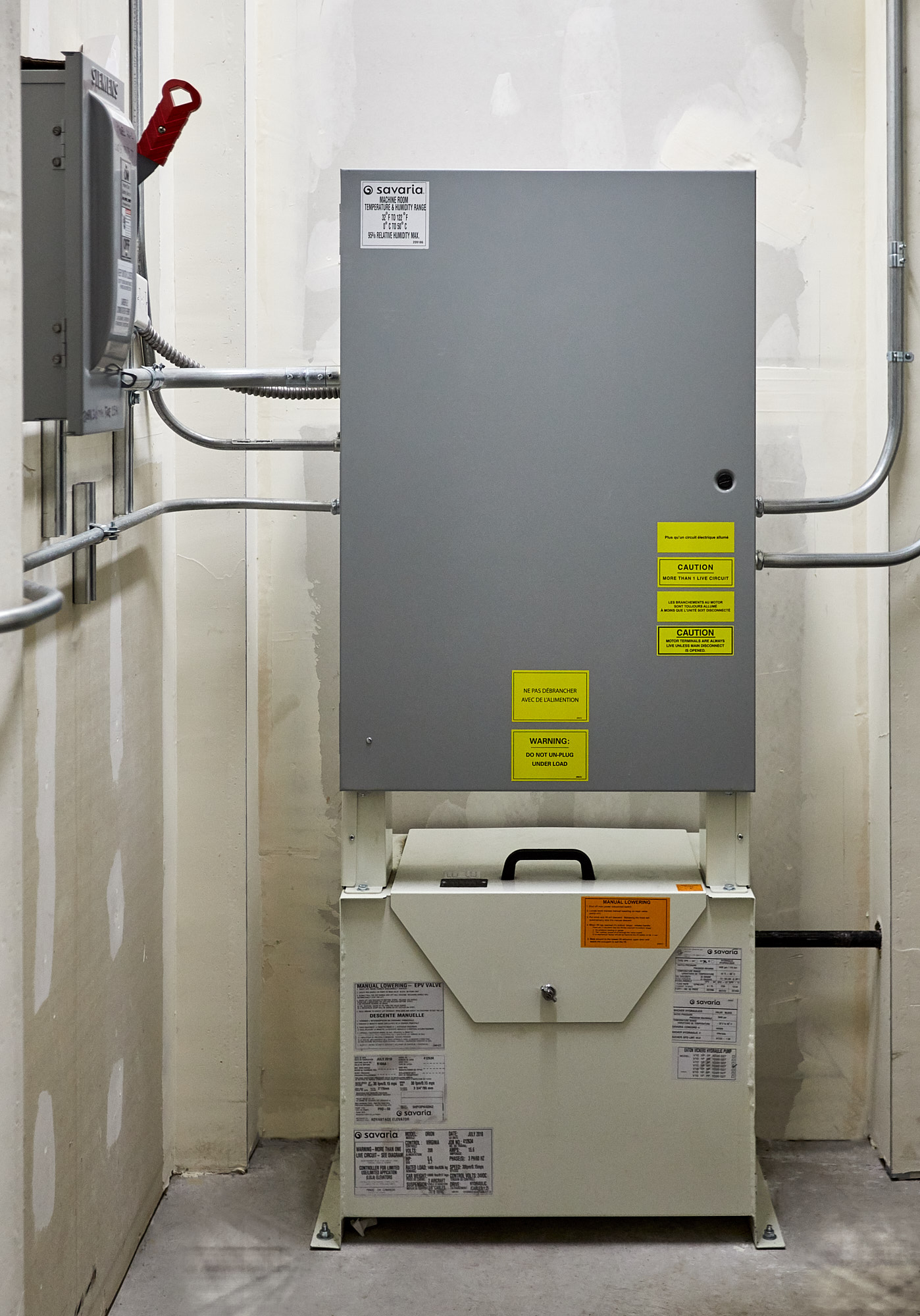
Electrical and hydraulic equipment

Framing and drywall around a hoistway

Finished landing door
Where surprises come from
The short answer
What we check
What to do next
1. Electrical: the item people forget
Every home elevator needs its own electrical circuit, and the requirement depends on the model. Here are the manufacturer figures for common Savaria models.
- Eclipse: a 230-volt, single-phase, 20-amp circuit with a 30-amp fused disconnect, plus a separate 120-volt, 15-amp circuit for the lighting.
- Infinity (hydraulic): 208-volt three-phase or 230-volt single-phase at 30 amps, plus a 120-volt, 15-amp lighting circuit.
- Zenith: 208-volt three-phase at 30 amps, or 240-volt single-phase at 40 amps, plus a 120-volt, 15-amp lighting circuit.
- Telecab and Luma: a dedicated 110-volt, 20-amp circuit.
- Stiltz Duo: a dedicated 220-volt circuit.
What can surprise you is not the circuit itself but the path to it. If your panel is full, far from the shaft, or already near its limit, an electrician may need to add capacity or run a long conduit through finished walls. Older houses sometimes need a panel upgrade. Part of the elevator’s electrical connection is in our scope; the main feed from your panel is usually the electrician’s. We tell you where the line is drawn in the quote. Also ask about local requirements for an outlet or light inside the shaft, and for any disconnect near the machinery.
2. Framing, drywall, paint and trim
An elevator shaft is a built enclosure, not a piece of furniture. In an existing house, someone has to frame the shaft walls, patch the floor and ceiling around the openings, and finish the walls with drywall, texture and paint. Shaft walls may need a fire rating, depending on the code that applies to your project, and that affects the wall materials. Around each door you will have trim, casing and sometimes new baseboard to match the house.
This work often belongs to a general contractor or to trades we coordinate with, and it can be one of the largest items outside the equipment. It is also the item most easily underestimated, because the finish work is slow and visible. Ask whether your quote includes it. If not, ask who does it and when.
3. Structural engineering and the pit
Cutting floor and ceiling framing for a shaft means an engineer may need to detail the structure. A pit in a slab foundation needs engineered reinforcement and a new base. Neither is a surprise to a good contractor, but both are real work with real trades. Our guide on slab foundations, pits and basements explains which elevators need a pit and which do not, because choosing a no-pit lift can remove an entire item from your list.
4. Permit, plan check and HOA review
Your city requires a building permit for the shaft, structure and electrical work, and the city’s fees and plan check are separate from the elevator price. We coordinate the permit and inspections. Fees vary by city, so we do not guess at them. Read our guide to home elevator permits in California for the details.
If you live in a community with an HOA, ask early whether the board reviews interior structural work and exterior changes. Some boards want drawings, some want a letter from the contractor, and some meet only monthly. A review that takes longer than expected will not cost you much money, but it can delay the project and hold up trades that are already booked. Starting the HOA conversation first is free.
5. Cab finishes, doors and options
A standard cab is a good elevator. The Eclipse, for example, offers melamine or unfinished MDF as standard, with luxury MDF, routed white MDF, veneer and solid hardwood as upgrades, and clear or bronze anodized or white powder-coat fixtures. Glass cabs, custom millwork, special doors, a touchscreen, a second door or a fold-away seat all change the total. See our custom elevator finishes and bifold elevator doors pages.
These are choices, not hidden costs, but they are the ones that move a quote most, and they are easy to add late. Decide what you want before you compare bids, so the quotes match.
6. Landing flooring and the connection to your home
Each landing needs a flush, finished floor. If you change flooring in the hallway, replace carpet or tile at the opening, or match hardwood across a new threshold, those flooring costs are on top of the elevator. Light fixtures, switches and wall finishes at each landing are the same. A well-finished landing looks like part of the house, and that polish is usually in the builder’s budget, not the elevator’s.
7. The phone line, monitoring and the rest of the long run
Most home elevators include an emergency alarm and a way to call for help from inside the car. Ask what your unit uses, whether that needs a phone line or a network connection, and whether you want a monitoring service that answers when someone presses the button. Monitoring is a recurring item, so ask about it up front.
Then there is the cost that continues after installation. Manufacturer warranties require regular maintenance, and owners should plan for annual or twice-yearly service. A service visit is a recurring item, and so are occasional repairs and, in time, replacement of wear parts. Homeowners in online threads mention this one often: they describe the annual service, and sometimes a recall or a repair, as the cost they felt most. We keep the details of service in our maintenance plan and explain what to expect in our guide to home elevator maintenance. Also tell your insurer about the elevator.
A simple way to protect your budget
Ask every company for the same four things in writing. First, a list of what is included. Second, a list of what is not included and who normally handles it. Third, the electrical requirement for the model you are quoted, so your electrician can price the line. Fourth, a timeline that shows where the permit and the HOA review sit. Then add an allowance for the items that belong to other trades.
That small amount of paperwork prevents most of the surprises people complain about. It also lets you compare bids fairly, which matters when one company’s quote is simply shorter because it leaves out half the project. For the timeline side, see our installation timeline guide.
Frequently Asked Questions
What are the hidden costs of installing a home elevator?
The common ones sit outside the equipment quote: electrical capacity and wiring, framing and finishing the shaft, structural engineering and a pit, permit fees, HOA review, landing flooring, cab upgrades, and ongoing service. We list what is and is not in our quote so nothing is a surprise.
Do home elevators use a lot of electricity?
Most home elevators use a modest amount of power because they run for short trips, but they need a dedicated circuit, and the circuit size depends on the model. For example, the Savaria Eclipse needs a 230-volt, 20-amp circuit plus a separate lighting circuit. The bigger issue is panel capacity, not your monthly bill.
Do I need to upgrade my electrical panel for a home elevator?
Sometimes. If your panel is full or already near its limit, an electrician may need to add capacity or upgrade it. We tell you the circuit the model needs, and your electrician checks it against your panel.
Does my HOA have to approve a home elevator?
Many HOAs review structural changes and anything visible from outside, and each community sets its own rules. Ask your HOA early what it requires. We provide drawings and letters from the contractor that boards often ask for.
Does homeowners insurance cover a home elevator?
Most homeowner policies treat a built-in elevator as part of the dwelling, but coverage varies. Tell your insurer about the installation and confirm in writing what is covered. A change in the value of your home can also affect your dwelling coverage.
What are the most overlooked factors when installing an elevator?
The usual ones are the electrical circuit and panel capacity, the finish work around the shaft, the pit in a slab foundation, the permit and HOA timeline, and the ongoing service. A written scope from each company helps you catch them before you sign.
Want the whole picture before you sign?
We put it all in writing, free. Call (833) 865-7887.




