
Types of Home Elevators for San Diego and Orange County Homes
Find the Right Fit for Your House
Six ways to lift a person between floors, and where each one fits
Home elevators differ mostly in how they lift the car. That choice sets how much space the elevator needs, how much noise it makes, what electrical service it takes and how it behaves in a power outage. There is no single best type. There is the best type for your floor plan, your stops and your budget.
Advantage Elevator is a Savaria Elite dealer. We also install Stiltz and Cambridge Elevating and service every major residential brand, so we can compare options without a bias toward one design. Below are the main types, with honest pros and cons and where each tends to fit in San Diego and Orange County homes. For prices, see our home elevator cost page.
- Hydraulic: Savaria Infinity, and Orion where code allows
- Traction, no machine room: Savaria Eclipse (chain) and Zenith (cable)
- Winding drum: Savaria Vuelift and Luma
- Through-floor hydraulic: Savaria Telecab
- Shaftless gear motor: Stiltz
- Pneumatic vacuum: serviced by Advantage
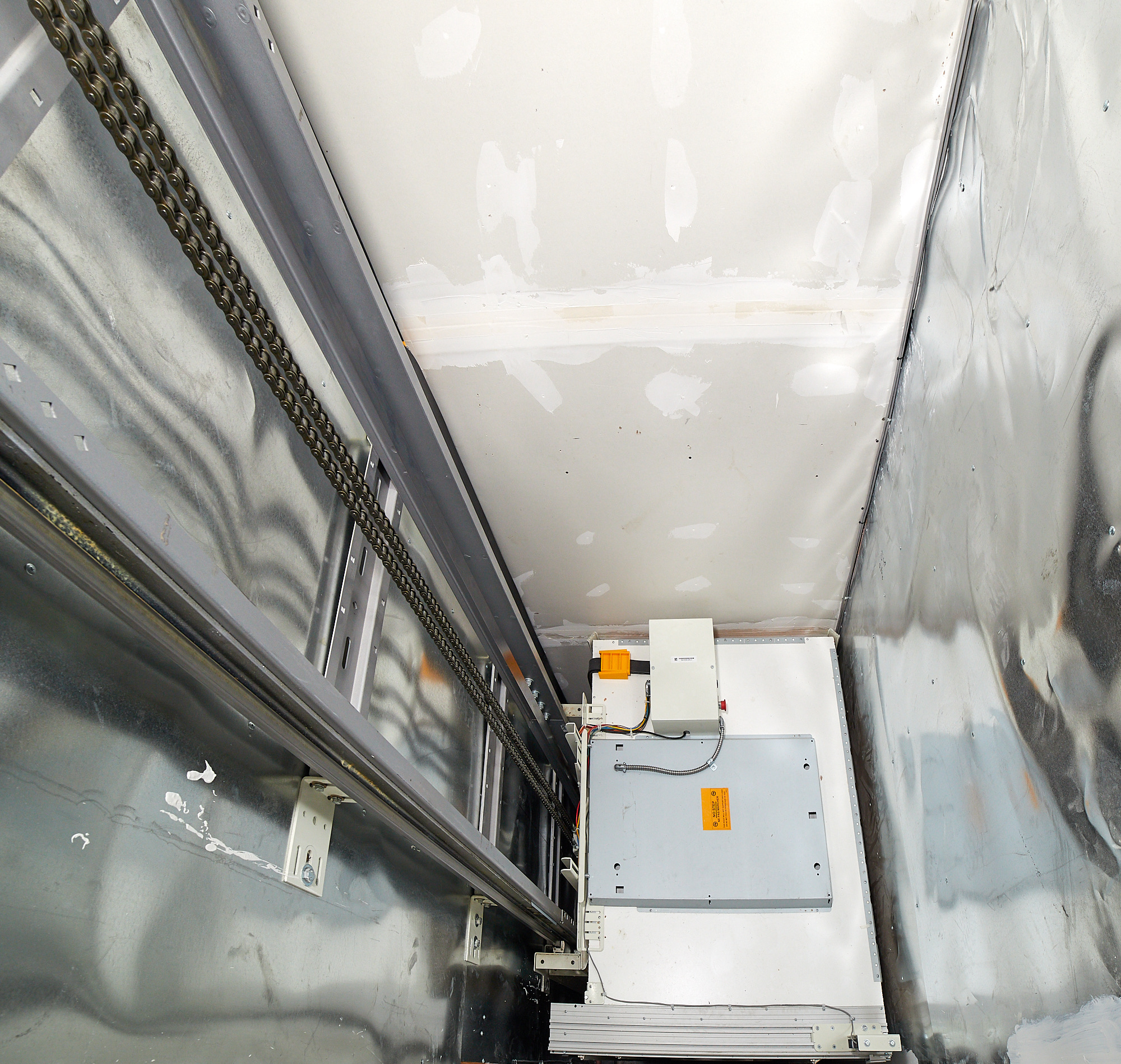
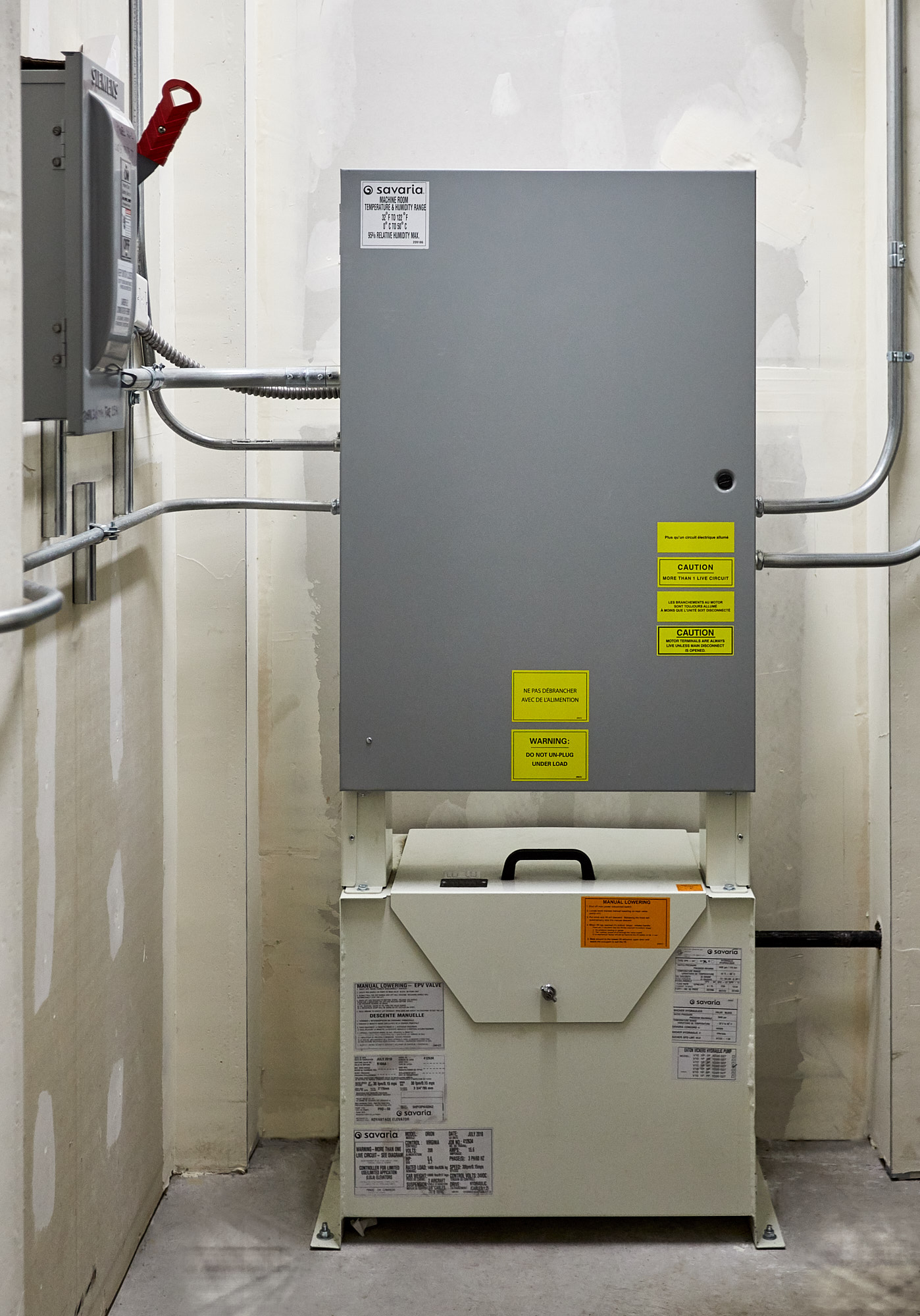
Hydraulic power unit

Winding drum drive on a Vuelift
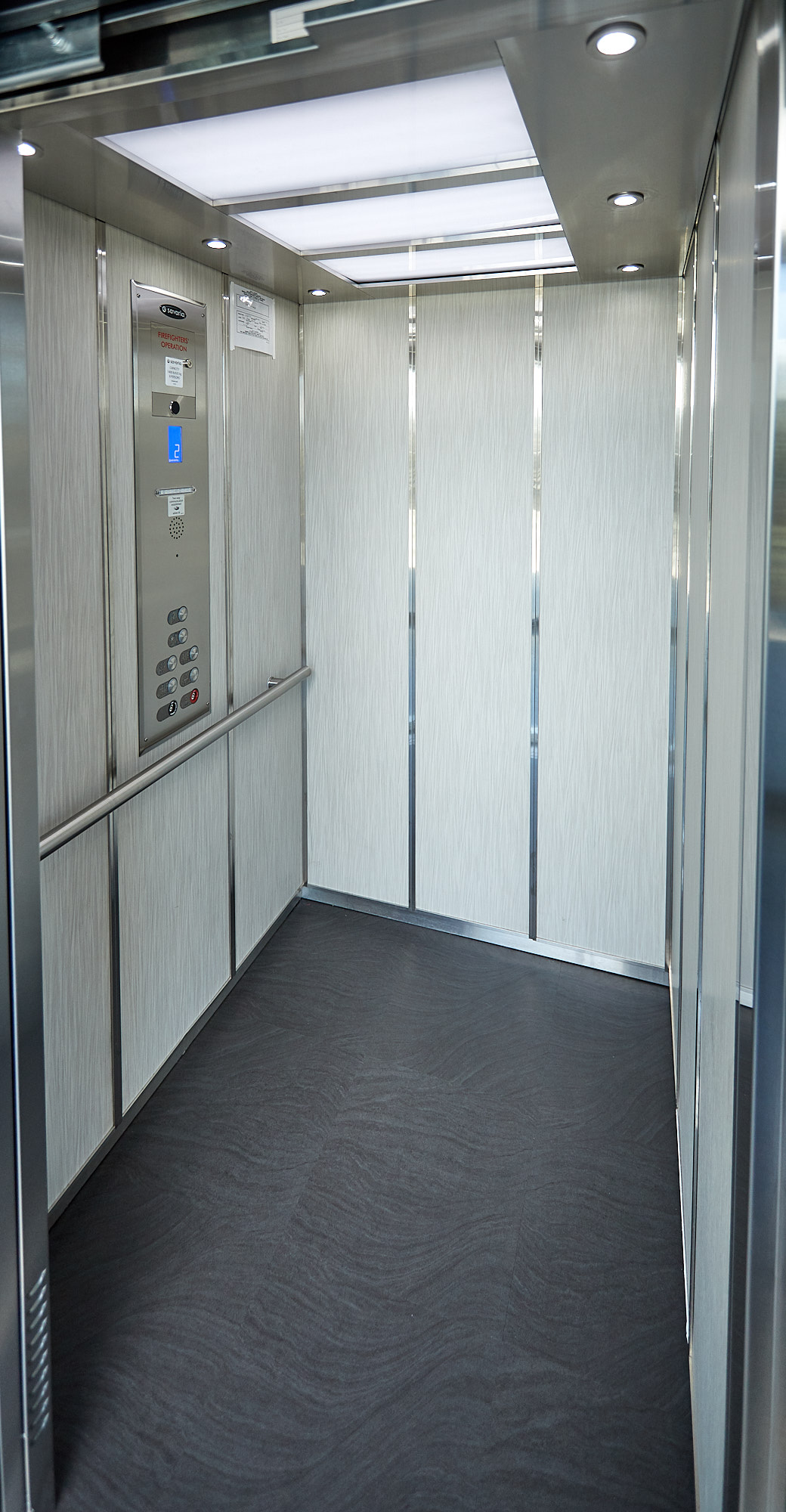
Traction elevator cab, stainless finish
The quick comparison
Hydraulic and traction
Winding drum, through-floor and shaftless
Pneumatic vacuum
Hydraulic elevators: Savaria Infinity and Orion
A hydraulic elevator lifts the car with fluid pressure. The Savaria Infinity uses a cable-hydraulic design with a submersible pump and motor and vegetable-oil fluid. It rates for 750, 950 or 1000 lb, with a heavy-duty Infinity HD at 1400 lb. It is known for quiet, smooth riding, and automatic leveling.
Pros: quiet, smooth, strong capacity, well proven. Cons: it needs a machine room of about 4 by 5 feet for the tank and controller, usually in a basement or utility area, and it needs a pit. Power: 208 V three-phase or 230 V single-phase, plus a lighting circuit. Where it fits: homes with a basement, garage or utility space close to the hoistway, and new builds where the machine room can be planned in. The Savaria Orion, a larger hydraulic unit with a 1400 lb rating, can serve homes where code allows and a bigger cab is wanted.
Traction elevators with no machine room: Eclipse and Zenith
A traction elevator pulls the car with chain or cable over a drive. The “MRL” in the trade name means machine-room-less. The Savaria Eclipse uses a geared roller-chain traction drive with a 2 hp top-mounted motor. The Savaria Zenith uses geared traction with three steel cables and is rated at 56 dB.
Pros: no machine room, a small pit, a compact footprint, and lower electrical demand on the Eclipse, which runs on a 230 V single-phase 20 A circuit. Cons: they need an overhead of 96 inches for the Eclipse and 108 inches for the Zenith, and a controller closet. Where they fit: homes where space for a machine room is hard to find. That includes many Orange County and San Diego custom homes, and tighter lots in Newport Beach and Encinitas where every square foot is spoken for. The Zenith’s higher 1400 lb rating suits larger cabs.
Winding-drum and shaftless options: Vuelift, Luma and Stiltz
The Savaria Vuelift is a panoramic elevator with a self-supporting, factory-built hoistway and a winding-drum drive on top of the car, so it has no machine room. The round and octagonal glass or acrylic cabs make it a design feature as well as a lift. Noise is about 65 dB, a little higher than the traction units. The Savaria Luma is a two-stop through-floor lift with a winding drum and a clear acrylic cab.
Stiltz is a shaftless home lift. A gear motor at the top runs on two vertical guides, and the lift arrives in modular sections small enough to go through a doorway. Stiltz says installation can take as little as one day. Pros: little construction, small footprint. Cons: smaller capacity and cab than a full elevator, typically two stops or a few floors, and it needs a dedicated 220 V circuit. See also shaftless home elevators.
Where they fit: homes that are finished, where cutting a shaft is hard, such as coastal condos, bluff-top homes and La Jolla hillside houses with tight interiors, and homeowners who want something to see through the glass.
Through-floor hydraulic lifts: Savaria Telecab
The Telecab runs between two stops through an opening cut in the floor. A hydraulic drive in an attached tower powers a roller-chain lift at 20 feet per minute. It carries 500 lb, or 845 lb on the Telecab 17, with travel up to 23 feet. It runs on a dedicated 110 V 20 A circuit.
Pros: a lower cost than a full elevator, no separate hoistway and a modest electrical need. Cons: two stops only, a smaller cab, and slower travel. Where it fits: two-story homes where a full shaft is not practical, and where the main goal is getting one person, or one person and a helper, between floors.
Pneumatic vacuum elevators
A pneumatic vacuum elevator moves a clear cylindrical car through a tube using air pressure. Typical models are compact, built for one or two riders, and plug into a household-style 220 V connection. We do not sell these. Advantage services pneumatic vacuum elevators, and we will tell you plainly if a repair is outside what we can do. If you have one and need service, call us.
How to choose
We start with five questions: How many floors do you need to serve? Where could the hoistway go? Is there a place for a machine room or a controller closet? Who will use it, including wheelchairs or walkers? And what is the budget? From the answers, most homes narrow to two or three types. A free in-home visit gets you a written comparison. Request one on our contact page, or see the full elevator lineup and the home elevator hub.
Frequently Asked Questions
What is the best type of home elevator?
There is no single best type. Hydraulic units are known for quiet, smooth rides but need a machine room. Traction units without a machine room save space. Through-floor and shaftless lifts reduce construction. We pick based on your floor plan, number of stops and budget.
Which type of home elevator is the quietest?
Savaria rates the Infinity hydraulic as quiet, and the Zenith traction at 56 dB. The Vuelift runs at about 65 dB. Actual sound in your home also depends on where the drive sits and how the hoistway is built.
Do all home elevators need a machine room?
No. The Eclipse and Zenith traction units, the Vuelift, the Luma, the Telecab and Stiltz do not need a separate machine room. A hydraulic unit such as the Infinity does, usually about 4 by 5 feet near the hoistway.
Can I add a home elevator to an existing house?
Yes. The best options for an existing home are usually a traction elevator with no machine room, a Vuelift, a through-floor lift or a shaftless lift. We look at your floor plan on a free visit and tell you what fits.
What happens to a home elevator when the power goes out?
Savaria elevators we install include battery lowering that brings the car to a floor so you can exit. We test the batteries on every service visit. Power shutoffs during wildfire season make this feature worth checking.
Not sure which type fits your home?
Free in-home consultation in San Diego and Orange County. Call (833) 865-7887.




