
Shaftless Home Elevators in California: Models, Sizes and Fit
Models, Sizes and Real Houses
What is a shaftless home elevator?
A shaftless home elevator is a lift that carries its own drive and guide rails, so nobody builds a framed hoistway, a pit or a machine room around it. You cut an opening in the upper floor, bring in the lift and run a power circuit. Most are two-stop lifts, and they are often the quickest way to put a lift into a house that is already finished.
This page covers how they work, the four shaftless lifts we install with their real sizes, and when a traditional elevator is the better answer. It also covers the California questions we hear most: permits, earthquakes, slab foundations, hillsides and fire-season power shutoffs. We install and service all of them, so we have no reason to push one over another.
Advantage Elevator is a licensed California elevator contractor (CSLB C-11 #1027832), a Savaria Elite dealer and a Stiltz and Cambridge Elevating installer, with more than 20 years in business and 4.9 stars across 300+ Google reviews. Our office is at 5857 Owens Avenue, Suite 300, Carlsbad, CA 92008, and we serve San Diego County and Orange County.
Already have a spot in mind? Measure it and try our home elevator size checker. It sorts every model by what fits.
- Four shaftless products compared by size, capacity, stops and power: Stiltz, Savaria Telecab, Luma and Vuelift
- Free in-home visit where we measure the stairs, the ceiling heights and the floor above
- We coordinate the building permit with your city’s building department
- 24/7 emergency service after the install
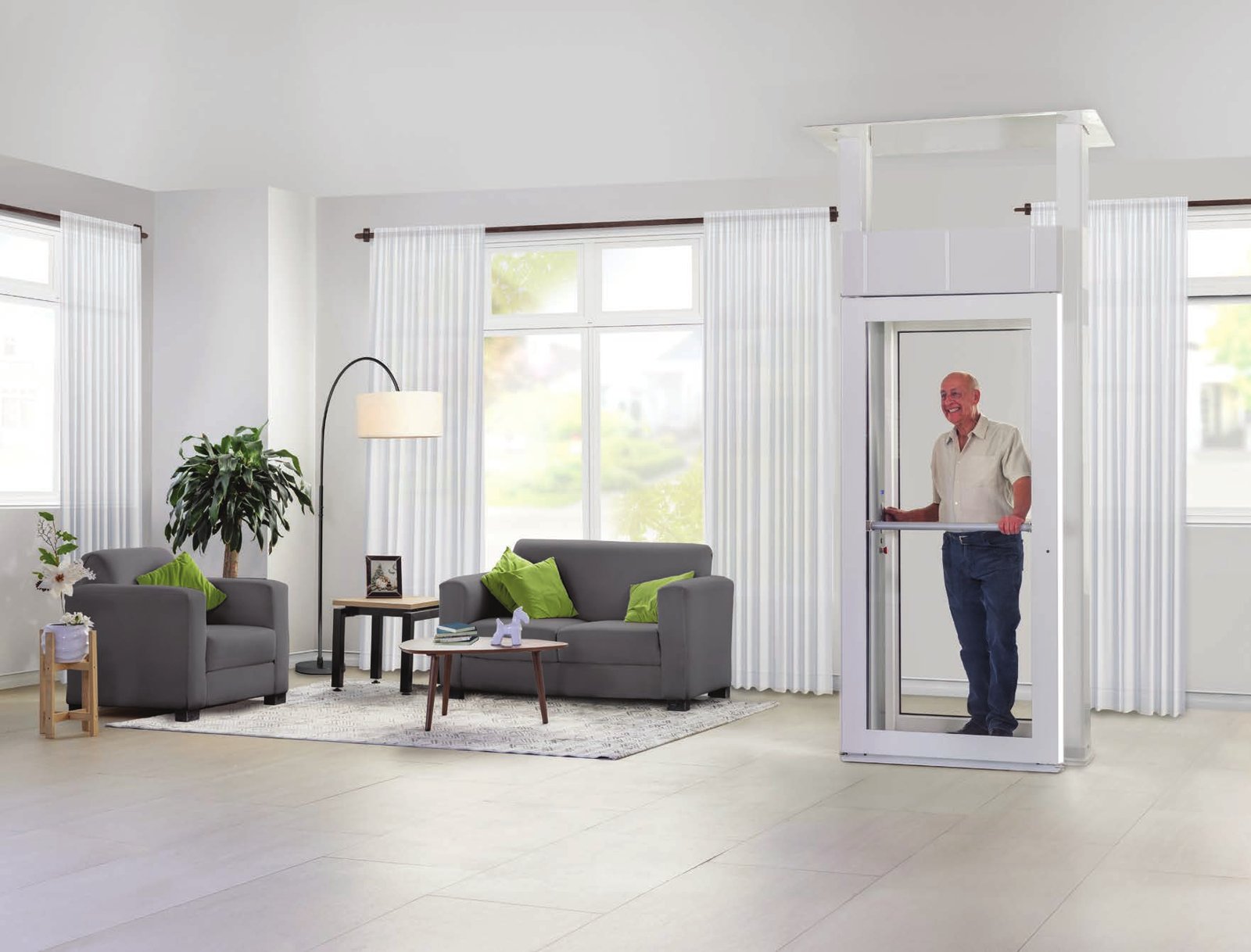
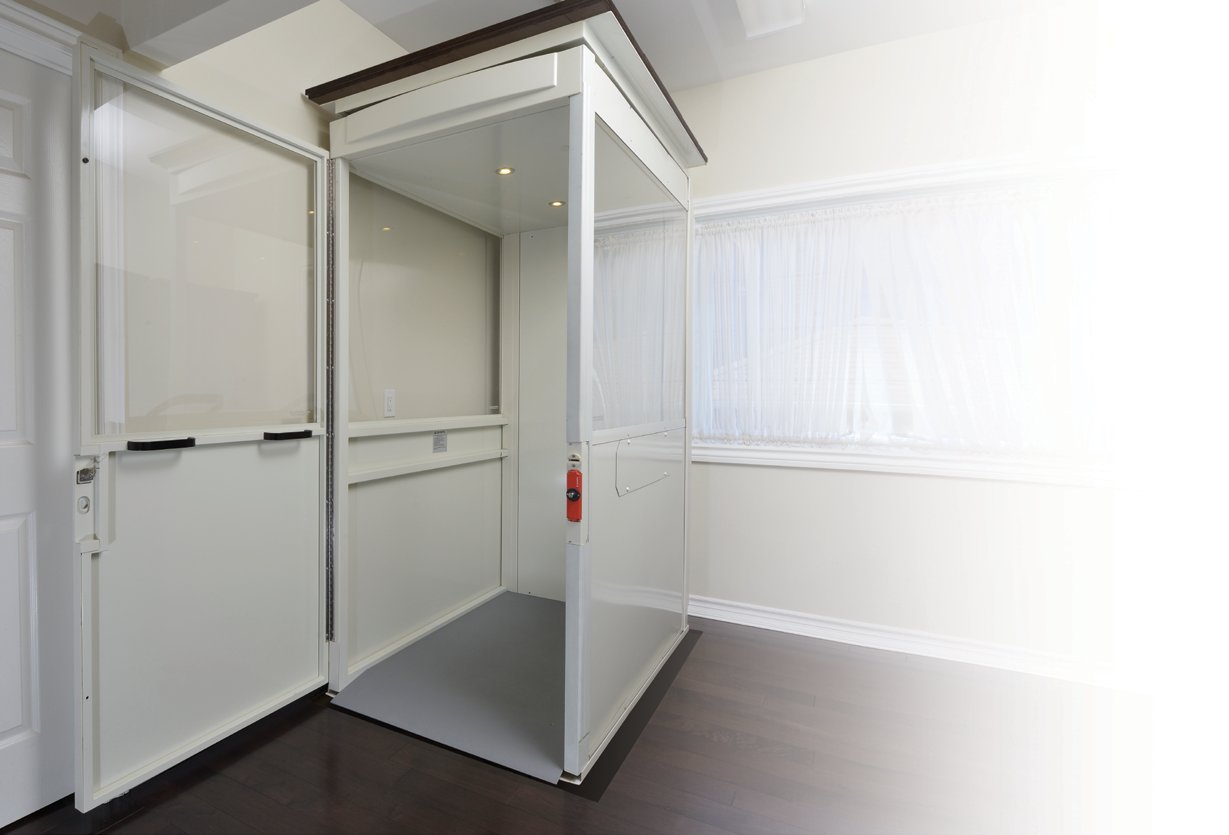
Savaria Telecab through-floor elevator
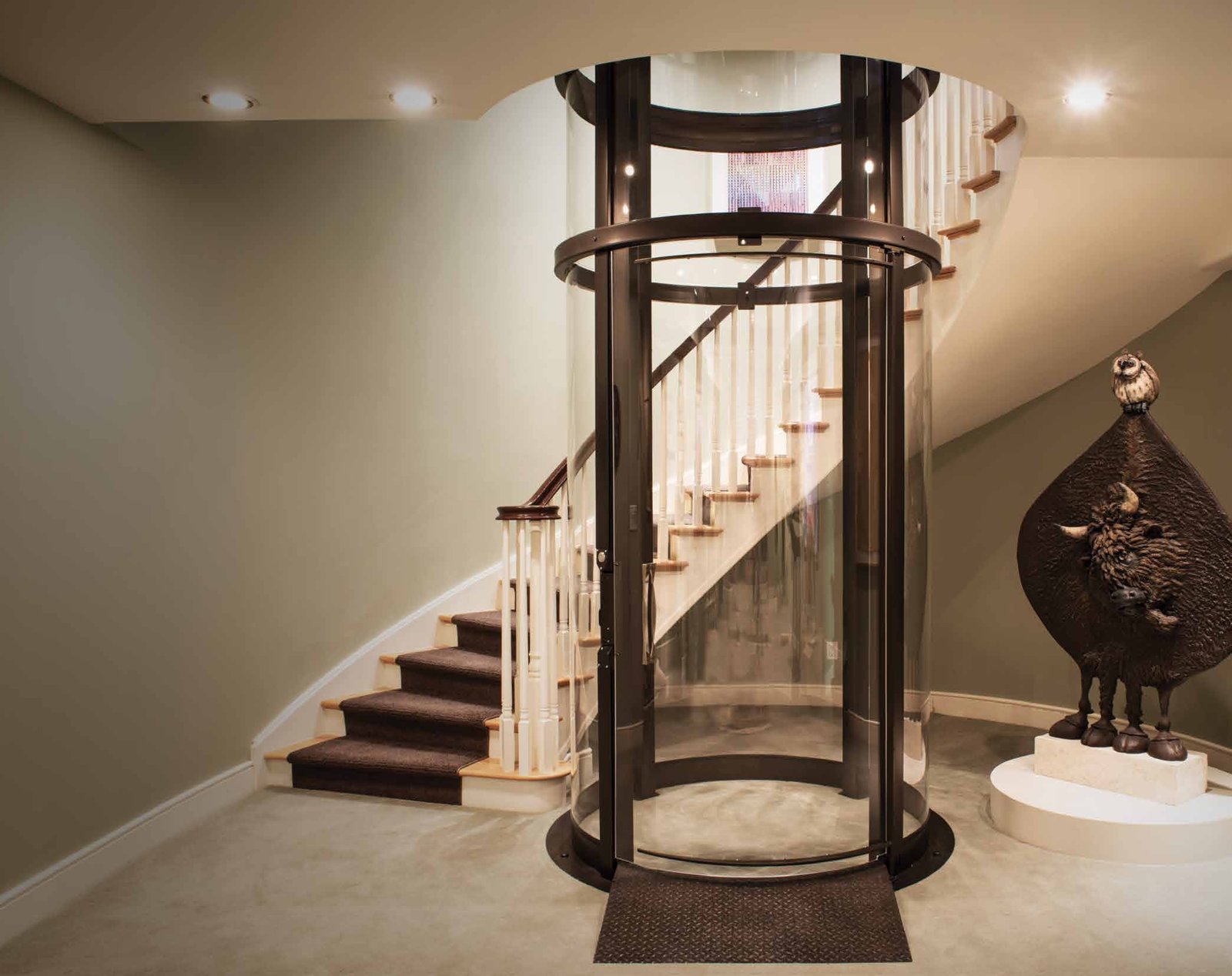
Savaria Vuelift self-supporting elevator
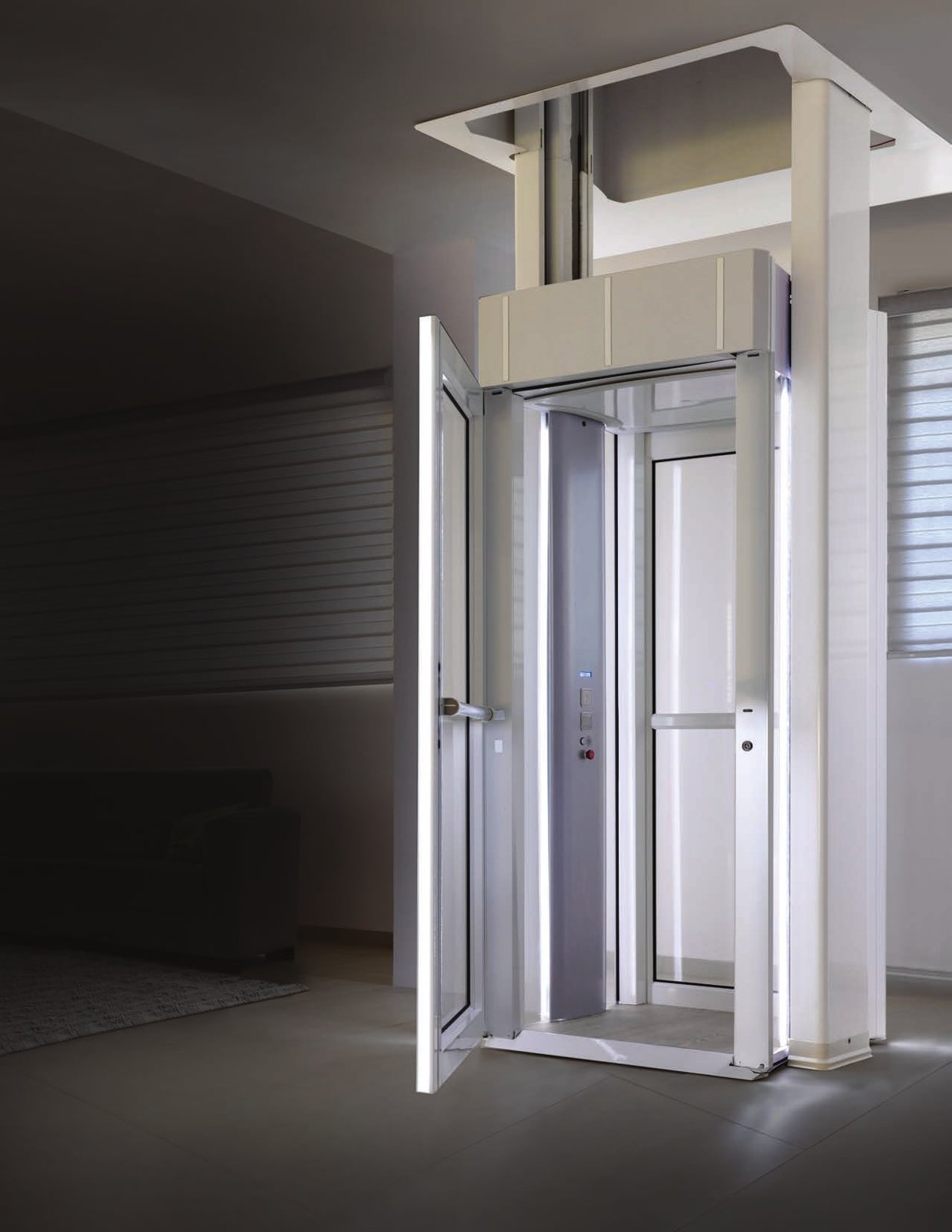
Savaria Luma lift
Three families of shaftless lift
Stiltz Duo and Trio
Savaria Telecab and Luma
Savaria Vuelift
How does a shaftless home elevator work?
A conventional home elevator runs in a hoistway that a builder frames and finishes inside the house. It also needs a pit under the lowest floor, clearance above the top floor, and a closet or machine room for the controller. In a house that is already built, that is a big construction project.
A shaftless lift removes the built hoistway. The word is used loosely, so it helps to split the products into two groups.
Truly shaftless. The Stiltz, Telecab and Luma carry their own drive and guides. Nothing is built around them except the opening in the upper floor. You can see the car and the tower or guide rails inside your room.
Self-supporting. The Vuelift brings its own factory-built hoistway. You do not build a shaft, but you do have a freestanding tower with a glass or acrylic wall, which is a design choice as much as an engineering one.
None of these means no construction. Every one needs a power circuit, clear space above the top landing and an opening through the upper floor. What you avoid is the framed shaft, the pit and the machine room.
Which shaftless home elevators do we install, and what size are they?
These numbers come from the manufacturers’ current planning guides and spec sheets. Floor cutout is the opening in the upper floor. Manufacturers call these sizes nominal, so the shop drawings for your house rule. Check your own space with the size checker, then we confirm on site.
| Model | Floor cutout (inches) | Capacity | Stops and travel | Pit | Overhead needed |
|---|---|---|---|---|---|
| Stiltz Duo Alta | 41 1/4 x 31 7/8 | 375 lb | 2 stops, up to 14 ft 9 in | None listed | 93 in |
| Stiltz Trio Alta | 50 3/8 x 41 1/4 | 550 lb (500 lb where code limits it) | 3 stops, up to 19 ft 8 in | None listed | 96 in |
| Savaria Telecab | 36 x 60 1/2, up to 46 3/4 x 60 1/2 | 500 lb | 2 stops, up to 23 ft | None listed | 96 in |
| Savaria Telecab 17 | 35 1/4 x 60 1/2 or 41 1/4 x 68 1/2, by cab size | 845 lb | 2 stops, up to 23 ft | None listed | 96 in |
| Savaria Luma | 37 3/4 x 46 3/4 | 400 lb | 2 stops, up to 13 ft 9 in | None listed | 94 1/2 in |
| Savaria Luma L | 45 7/8 x 51 1/8 | 500 lb | 2 stops, up to 13 ft 9 in | None listed | 94 1/2 in |
| Savaria Vuelift Mini | 46 in round hole | 500 lb | Up to 6 stops, up to 50 ft | 3 in | 96 in |
The larger Vuelift models carry 840 to 950 lb in glass or acrylic and take round or octagonal cutouts from about 49 5/8 to 59 1/8 inches. The Vuelift has its own tower, so we size it from the planning guide for the exact model. Where a guide lists no pit, we read a pit of zero from the drawings, and we confirm that on your site.
Power is the other number to plan for. The Telecab, Telecab 17 and Luma run on a dedicated 110 V, 20 A circuit. The Stiltz Duo runs on a dedicated 220 V circuit. Ask us for the current spec sheet on the Trio Alta.
Do you need a shaftless lift or a traditional home elevator?
Pick a shaftless lift when the house is finished, you want two stops and you would rather not build a shaft. Pick a traditional elevator when you need more than a shaftless lift can give. Use this as a starting point. We confirm it on site with a tape measure.
- Two floors and a tight corner or closet: the Stiltz Duo Alta or the Luma are the smallest openings on this page. The Duo needs 41 1/4 by 31 7/8 inches.
- Two floors and heavier loads: the Telecab 17 is rated for 845 lb. Cab size and door position matter, so we compare them to the chair or equipment you actually use.
- Three floors: the Stiltz Trio Alta serves up to three stops. The Vuelift reaches up to six.
- Open stairwell, you want the lift to be a feature: the Vuelift in glass or acrylic.
- More stops, a large cab or high-capacity use: a conventional elevator such as the Savaria Eclipse, which carries 750 to 1,000 lb and serves up to six stops, may be the honest answer. We will say so.
- Only stairs are the problem: a stairlift may do the job. See stairlift or home elevator.
- A split-level or hillside layout: bring the floor plan. A two-stop lift only joins two floors.
For the full range of lifts and elevators, see our guide to types of home elevators.
Are shaftless home elevators safe?
Yes, when they are installed correctly and serviced on schedule. The lifts on this page stop and hold at a landing when the safety circuit opens, whether the cause is a door fault, a loss of power or a tripped safety device. We test the controls, doors and safety devices at the end of every install and again at every service visit.
In an earthquake, the answer is plain. If you are riding when shaking starts, press stop if you can, stay in the car and call for help when it ends. If you are on a landing, do not step in. After a quake, do not restart the lift yourself. Our technicians check the guides or rails and their fasteners, the doors and interlocks, the drive and the wiring, reset the safety circuit and test the lift before it goes back into use. We give priority to homes where someone depends on the elevator. We cannot promise a time after a major regional event, and no honest company can. Our guide to home elevators and earthquakes goes through it step by step.
One practical point about shaftless lifts: the floor opening is a framed part of your house, and the guides or tower are fastened to it. We look at how it is tied into the structure when we design the installation. If young children live in or visit the house, read our guide to home elevator child safety.
Do you need a permit for a shaftless home elevator in California?
People often hear two stories and think one of them must be wrong. Both are right, because they describe two different systems.
California’s Cal/OSHA runs the state elevator program under Title 8. Section 3000(a) exempts an elevator in a single-unit private home that is not open to the public. So a typical single-family house does not carry a state operating permit or periodic state inspection for its elevator.
That does not mean the lift goes in without paperwork. Your city or county building department still regulates the floor opening, the framing around it, the structure underneath and the electrical circuit, and it typically wants a building permit and a plan check before work begins, then inspections. We coordinate with your city’s building department, prepare the drawings it asks for and schedule the inspections. We cannot promise an outcome, because the city decides.
So the answer is to expect a city building permit, not a state elevator permit. For the full explanation, read our guide to home elevator permits in California.
What do shaftless lifts need in a Southern California house?
A product that suits a Midwestern basement house does not always suit ours. Here is what we look at on our side of the state.
Slabs and stem walls. Most Southern California homes sit on a concrete slab or a short stem wall, not a basement. That is one reason people choose shaftless lifts. The Stiltz, Telecab and Luma list no pit, so nobody cuts the slab at the lowest floor. A conventional elevator usually does. The Vuelift needs a shallow pit, which is 3 inches for the Mini and 4 inches for the larger models, or an access ramp on the models that offer one. Our guide to slab or basement homes explains the difference.
The floor cutout and closet stacks. Every one of these lifts needs an opening through the upper floor. We check the joists, the framing and what sits above the opening before we order anything. A beam or a bearing wall in the wrong place changes the plan. The easiest installs line up one room above another, a closet over a closet or a corner of a living room over a corner of a den. If the rooms do not stack, we can often still do it, but we sketch the room before we promise.
Hillside and split-level homes. In La Jolla, Point Loma, Laguna Beach and Anaheim Hills, the garage may be one level, the kitchen another and the bedrooms a third. A two-stop lift only joins two floors, so a split-level plan may need a different choice. Narrow canyon streets and long stair carries also decide how equipment arrives, and a lift built in sections, such as a Stiltz, travels well.
Coastal salt air. Homes near the beach, the bay or a lagoon see salt and humidity. We look at where the lift will sit, how exposed the controller and connections are and how often it should be serviced.
HOA design review. Many communities in Mission Viejo, Carlsbad, Rancho Bernardo and Coto de Caza have architectural committees. Work inside the house is usually less affected than anything visible from outside, but ask your association before you sign. We provide drawings and finish samples for the submission.
Wildfire-season power shutoffs. Utilities in San Diego and Orange counties sometimes shut off power to reduce fire risk. Most modern units can lower the car to a landing and open the door on battery power. That is for getting out, not for continued use. The Luma has a built-in battery rated for about five round trips. On other models, a backup battery is an option or varies by model, so ask us what yours includes.
What does a shaftless install involve, and how long does it take?
Shaftless does not mean effortless. We start with a free in-home visit, then handle the drawings, the permit, the floor opening, the electrical circuit, the lift and the final testing.
Ceiling height. The Telecab needs at least 96 inches of overhead, with 92 inches allowed under some conditions. The Luma needs 94 1/2 inches, the Stiltz Duo Alta 93 inches and the Trio Alta 96 inches. We measure before we quote.
The electrical circuit. We bring our electrician or coordinate with yours, and the permit covers it.
The schedule. Stiltz says an installation can take as little as one day, though that depends on the floor work around it. We give you a written schedule with your quote. For pricing, we quote after a free in-home visit; see what a home elevator costs. Weighing a retrofit against a bigger project? Our guide to adding an elevator to an existing home covers the full picture.
Service. Like any lift, a shaftless unit needs regular maintenance. Our maintenance plans include a full inspection and safety-device testing, and they satisfy the maintenance requirement in the manufacturer warranty.
Frequently Asked Questions
Are shaftless home elevators safe?
Yes, when installed correctly and serviced on schedule. They stop and hold at a landing when the safety circuit opens, such as a door fault, a loss of power or a tripped safety device. We test the controls, doors and safety devices at the install and at each service visit.
How much space does a shaftless home elevator need?
It depends on the model. The smallest floor opening on our list is the Stiltz Duo Alta at 41 1/4 by 31 7/8 inches. The Luma needs 37 3/4 by 46 3/4 inches, and the Telecab starts at 36 by 60 1/2 inches. Overhead clearance runs 93 to 96 inches. Use our size checker, or we will measure for free.
Does a shaftless home elevator need a pit?
The Stiltz, Telecab and Luma lists no pit in the manufacturers’ guides, so the slab at the lowest floor stays intact. The Vuelift is a self-supporting tower and needs a shallow pit, 3 inches for the Mini and 4 inches for the larger models, unless the model uses an access ramp. We confirm this on your site.
Can a shaftless elevator go up more than one floor?
Some can. The Luma, Telecab and Stiltz Duo Alta serve two stops. The Stiltz Trio Alta serves three, up to 19 ft 8 in of travel. The Vuelift can serve up to six stops. If you need three or more stops, tell us early so we pick the right product.
Can a shaftless elevator carry a wheelchair?
Some can. The Stiltz Trio Alta is rated for wheelchair use at 550 lb, or 500 lb where code limits it. The Telecab 17 is rated for 845 lb, but cab size and door position decide whether a given chair fits, so we compare them to your chair. Bring the model of your chair to the free measure.
Not sure which lift fits your house? We’ll measure and tell you.
Free in-home estimate in San Diego and Orange County. Call (833) 865-7887.


